10 Set Retro and Vintage Line Patterns: Timeless Design Meets Modern Digital Workflow
In an era where digital interfaces grow increasingly saturated with bold gradients, 3D effects, and AI-generated visuals, a quiet but powerful counter-movement is gaining momentum: the return of intentional minimalism—expressed through retro and vintage line patterns. The 10 Set Retro and Vintage Line Patterns isn’t just another asset pack—it’s a curated response to evolving creative needs across branding, web design, product development, and visual storytelling. Designed for professionals who value authenticity, efficiency, and aesthetic cohesion, this collection bridges nostalgic sensibility with contemporary technical flexibility.
What Is the 10 Set Retro and Vintage Line Patterns?
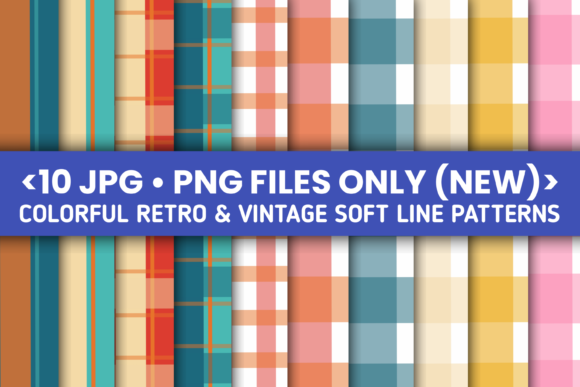
The 10 Set Retro and Vintage Line Patterns is a thoughtfully assembled bundle of hand-crafted line-art motifs inspired by mid-century modernism, Art Deco geometry, 1970s organic abstraction, and analog printing textures. Each pattern is built from clean, deliberate strokes—no pixelated noise, no forced “grunge”—but rather confident, rhythmic linework that evokes craftsmanship and human intention. Unlike algorithmically generated repeats or overused stock motifs, these patterns were conceived as functional design systems: scalable, adaptable, and context-aware.
Each of the ten patterns is delivered in three universal formats:
- JPG (5000 × 5000 px) — high-resolution, ready for print, presentations, or background overlays;
- PNG — transparent-background versions ideal for layering over photos, UI mockups, or social media assets;
- SVG — vector files generated directly from Infinite Design, ensuring infinite scalability without quality loss—perfect for responsive websites, app icons, or embedded illustrations.
This multi-format delivery reflects a deeper understanding of how designers actually work today: fluidly moving between mobile ideation, desktop refinement, and cross-platform deployment.
Designed on Device, Refined for Purpose
Every pattern in the 10 Set Retro and Vintage Line Patterns was initially sketched and composed using Infinite Design—a powerful vector illustration app built for smartphones and tablets. This isn’t a limitation; it’s a strategic advantage. Mobile-first creation enables rapid iteration, on-the-go inspiration capture, and intuitive gesture-based control—particularly valuable for line-art precision. What sets this collection apart is its disciplined post-processing: final cleanup, alignment optimization, and export calibration were performed in Pixellab, ensuring pixel-perfect fidelity and consistent stroke weight across all outputs.
The result? A set of symbols and icons that retain expressive character while meeting professional production standards. These aren’t decorative flourishes—they’re functional design elements. Whether used as subtle website backgrounds, brand watermark motifs, packaging texture layers, or minimalist app navigation icons, each pattern supports clarity—not distraction.
Why Retro Line Patterns Are Resonating Now
Retro and vintage aesthetics are not trending because they’re “old.” They’re resonating because they answer urgent contemporary needs:
- Visual breathing room. As attention spans shrink and interfaces multiply, users instinctively favor interfaces with clear hierarchy and uncluttered rhythm. Line patterns provide structure without heaviness—guiding the eye without competing for focus.
- Brand differentiation in saturated markets. In industries like wellness, independent publishing, boutique retail, and sustainable goods, consumers increasingly associate hand-drawn line art with authenticity, care, and intentionality—qualities difficult to replicate with AI-generated visuals.
- Efficiency in scalable design systems. With SVG support baked in, these patterns integrate seamlessly into design tokens, Figma libraries, or CSS background-repeat workflows—reducing file bloat and speeding up prototyping cycles.
- Cross-generational resonance. Millennials and Gen Z respond strongly to design languages that reference analog culture—not as pastiche, but as emotional shorthand for warmth, craft, and continuity.
Consider real-world applications: A freelance designer uses one of the patterns as a subtle animated border in a SaaS dashboard, reinforcing brand identity without interfering with data legibility. A small-batch ceramic studio applies another as a foil-stamped motif on packaging—its clean lines translate flawlessly from screen to embossing die. An e-commerce startup embeds a third as a loading-state animation, replacing generic spinners with motion-infused line rhythm. These aren’t hypotheticals—they’re documented use cases emerging across creative communities.
Beyond Decoration: Functional Design Intelligence
What makes the 10 Set Retro and Vintage Line Patterns especially valuable is its functional intelligence. Because each pattern originates from lineart principles—and was built in Infinite Design with vector-native constraints—the spacing, repetition intervals, and anchor points are mathematically coherent. That means:
- No visible seams when tiled across large surfaces;
- Consistent optical weight at any scale—from favicon size to billboard resolution;
- Easy customization in design tools: change stroke color, adjust opacity, or apply blend modes without degradation;
- Natural compatibility with dark mode interfaces, since line-based contrast adapts more gracefully than complex tonal imagery.
This level of engineering reflects a broader shift in digital asset expectations: creators no longer want “pretty pictures.” They want design-ready components—assets engineered for reuse, adaptation, and integration.
Aligning with Broader Creative and Technological Shifts
The rise of mobile-native design tools like Infinite Design signals a democratization of vector authoring—not just in access, but in workflow philosophy. Designers no longer need to begin on desktop software to produce production-grade assets. This mirrors larger industry movements: the growth of design-system-as-code, the adoption of component-driven UI frameworks, and the increasing expectation that visual assets perform as well as they look.
Moreover, the emphasis on line-based expression aligns with accessibility best practices. High-contrast, low-noise patterns improve readability for users with visual processing differences. Their simplicity also supports faster page loads and lower bandwidth consumption—critical considerations for global audiences and performance-focused platforms like Shopify or Webflow.
From a business standpoint, this collection serves entrepreneurs building lean, values-driven brands. It offers immediate visual distinction without requiring custom illustration budgets—yet avoids the homogenization associated with template-based design. It’s a rare balance: accessible, distinctive, and technically sound.
Who Benefits Most—and How
Professionals across disciplines are integrating the 10 Set Retro and Vintage Line Patterns into their daily practice:
- Freelance designers use them to accelerate client proposals—embedding patterns into mood boards or interactive prototypes to convey tone before committing to full visual identity development.
- Marketing teams deploy them as consistent visual anchors across email campaigns, landing pages, and ad creatives—ensuring brand recognition without repetitive imagery.
- Startup founders leverage the SVG files to build cohesive micro-interactions (e.g., hover states, progress indicators) that reinforce personality without slowing development.
- Content creators apply PNG versions as subtle overlays on video thumbnails or podcast cover art—adding depth and memorability without obscuring key messaging.
- Educators and workshop facilitators use the JPG files as teaching examples for discussing rhythm, negative space, and historical design lineage in digital contexts.
Crucially, none of these applications require advanced technical skill. The formats are interoperable, the documentation is implicit in the file structure, and the aesthetic logic is self-evident—making the collection both powerful and inclusive.
A Resource Built for the Next Phase of Digital Expression
The 10 Set Retro and Vintage Line Patterns represents more than a toolkit—it reflects a maturing digital design ethos. One that values restraint over excess, intention over automation, and longevity over virality. As tools evolve and platforms multiply, the demand for assets that behave predictably, communicate clearly, and age gracefully will only intensify.
These patterns don’t shout. They invite. They don’t replace strategy—they support it. And in a landscape crowded with disposable visuals, that kind of quiet confidence is becoming the most valuable design trait of all.