Ukrainian Seamless Ethnic Patterns
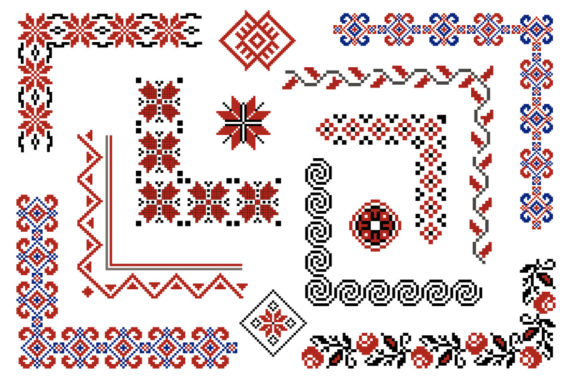
Ukrainian Seamless Ethnic Patterns are more than decorative assets—they’re culturally grounded, production-ready design tools built for real-world use. These aren’t generic “ethnic” motifs slapped onto a repeat grid. They’re carefully researched, digitally reconstructed, and technically optimized patterns rooted in regional Ukrainian textile traditions—especially those used in embroidery (vyshyvanka), weaving, and folk costume ornamentation. Each pattern flows seamlessly across any surface without visible joins, making them ideal for digital and physical applications where continuity matters: fabric printing, web backgrounds, packaging, UI overlays, educational visuals, or hand-embroidery templates.
What Makes These Patterns Stand Out
First, authenticity meets precision. Unlike AI-generated approximations or stylized interpretations, this set draws from documented 19th–early 20th century sources—field sketches, museum textile archives, and ethnographic publications from regions like Poltava, Hutsulshchyna, Podillia, and Slobozhanshchyna. The floral motifs reflect native flora: viburnum (kalyna), periwinkle (barvinok), hop vines, and wheat sheaves—each carrying symbolic meaning. Geometric elements—rhombuses, meanders, and stepped crosses—follow traditional compositional logic, not arbitrary symmetry.
Second, they’re truly seamless—not just tiled, but engineered. Every edge aligns pixel-perfectly at all standard resolutions, with no distortion, blur, or artificial blending. That means you can scale a corner motif to wrap around a book cover or stretch a floral band across a 4K website hero section—without manual retouching.
Third, they’re editable by design. Delivered in layered vector (AI, EPS) and high-res raster (PSD, PNG) formats, each pattern includes clearly labeled components: base repeat tile, isolated corner variants, standalone border elements, and modular ornaments (roses, rosettes, finials). You’re not locked into fixed colorways—adjust palettes in seconds using global swatches or HSL sliders. Swap a red-and-black Hutsul scheme for muted ochre-and-sage to match a wellness brand’s aesthetic, or extract a single vine element to animate in After Effects.
Where These Patterns Deliver Real Value
Creative professionals use them as time-saving foundations—not creative crutches. A textile designer developing a capsule collection for a sustainable fashion label might layer a Poltava-style floral repeat with custom-dyed linen textures, then isolate corner motifs to frame garment hems. A motion designer animating a cultural documentary intro could stagger geometric elements along a path, syncing pulse and rhythm to traditional dumka melodies.
Educators and publishers find immediate utility in the contextual clarity. The set includes metadata-rich naming (e.g., Poltava_Striped_Band_Variant3) and region-coded thumbnails—no guesswork when building lesson plans on Slavic ornamental language. History teachers project seamless borders behind timelines; art students deconstruct composition rules by toggling layers on and off in Illustrator.
Small business owners and makers benefit most from commercial practicality. One Etsy seller of handmade ceramic mugs uses the corner elements as subtle rim accents—exporting clean SVGs for laser engraving. Another prints the full floral repeat onto organic cotton tea towels, adjusting contrast for optimal ink absorption on natural fibers. Because every file is print-ready at 300 DPI and includes bleed guides, there’s no last-minute panic before sending to the printer.
Digital product teams integrate these patterns thoughtfully—not as clichéd “folk” wallpaper, but as meaningful UI texture. A Ukrainian-language learning app uses a low-opacity geometric dot pattern as a subtle background for flashcards, reinforcing cultural context without competing with content. A nonprofit promoting rural heritage tourism applies a vine-and-berry border as a consistent visual anchor across landing pages, email headers, and social banners—building recognition without heavy branding overhead.
Practical Tips Before You Use Them
- Start with intent, not aesthetics. Ask: Is this pattern supporting storytelling, usability, or identity? A bold black-and-red Hutsul motif may energize a festival poster but overwhelm a meditation app interface. Match visual weight to function.
- Respect proportion and scale. Traditional Ukrainian patterns rely on rhythm—not density. When scaling a seamless repeat, check how elements read at actual usage size. A 12-pt embroidered motif loses legibility if shrunk to fit a 24×24px favicon. Instead, use the included standalone elements for small-scale applications.
- Test across mediums. A pattern that looks rich on screen may flatten on uncoated paper or shift hue on dye-sublimation fabric. Always soft-proof in CMYK and order physical samples before bulk production.
- Layer meaning, not just visuals. If your project has cultural resonance—say, a diaspora community center’s rebrand—pair the pattern with brief, accurate context in captions or footnotes. It signals respect and invites deeper engagement.
Why “Seamless” Isn’t Just a Technical Feature
In Ukrainian craft tradition, continuity carries intention. Embroiderers didn’t stitch isolated flowers—they wove symbols into unbroken lines representing life, protection, and connection. That philosophy translates directly to digital use: a seamless pattern doesn’t just hide seams—it creates cohesion. Whether it’s a brochure binding two sections visually, a website background that guides the eye smoothly down the page, or fabric that flows uninterrupted over a garment’s curve, Ukrainian Seamless Ethnic Patterns support unity of form and purpose.
They also reduce friction. No more hunting for matching corners, manually cloning tiles, or troubleshooting alignment in Figma. That reclaimed time adds up—whether you’re iterating a client presentation or prepping materials for a weekend craft workshop.
And importantly, they offer flexibility without compromise. You don’t sacrifice cultural fidelity to get technical polish—or vice versa. The set bridges archival rigor and modern workflow needs, so you spend less time fixing files and more time communicating, creating, and connecting.