Watercolor Patterns “Underwater Life”
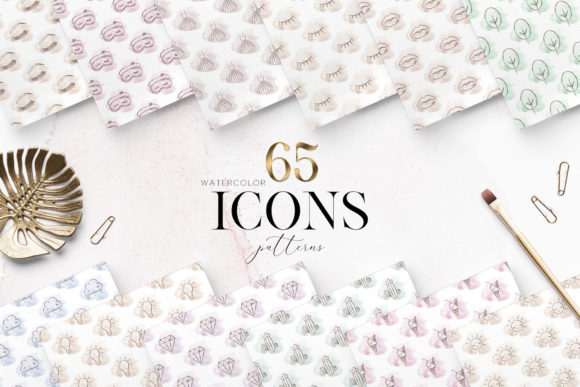
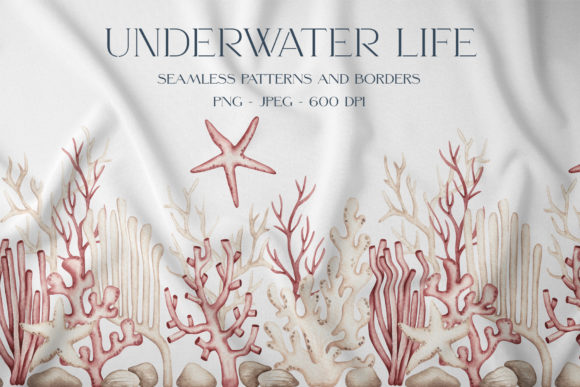
Watercolor Patterns “Underwater Life” is a curated digital collection of hand-drawn, ocean-themed seamless patterns and decorative borders. Each design features organic watercolor textures and stylized marine motifs—including coral, seahorses, jellyfish, sea anemones, kelp, starfish, and abstract wave forms—rendered in soft, translucent layers typical of traditional watercolor technique. The set includes 10 unique pattern files delivered as high-resolution PNGs with transparent backgrounds and JPEGs on pre-selected colored backgrounds (e.g., aqua, deep teal, sand beige). All files are sized at 5000×5000 pixels and output at 600 dpi, supporting both digital and large-format print applications.
Who Might Consider This Collection?
This collection appeals to designers, illustrators, surface pattern designers, educators, and craft professionals evaluating resources for projects involving nature-inspired aesthetics and tactile visual texture. It is especially relevant when the goal is to introduce gentle, non-repetitive organic rhythm into layouts—without relying on photographic or vector-based assets. Users often compare Watercolor Patterns “Underwater Life” against generative AI outputs, stock pattern subscriptions, or custom illustration commissions. Its value lies not in novelty alone, but in its consistency of medium, scale, and stylistic cohesion across all 10 patterns.
Key Benefits
- Authentic watercolor texture: Unlike digitally simulated brushes or rasterized vector fills, these patterns preserve natural pigment bleed, granulation, and subtle paper grain—qualities difficult to replicate algorithmically.
- Seamless scalability: At 5000×5000 px and 600 dpi, each pattern tile maintains clarity from web display to wallpaper-scale printing. Transparency support allows flexible layering over gradients, photos, or textured substrates.
- Design efficiency: The inclusion of both transparent and color-backed JPEG versions reduces time spent adjusting contrast or background matching during mockup stages.
- Cohesive visual language: All motifs share a unified palette, line weight, and compositional density. This supports brand consistency in multi-element projects like stationery suites, textile lines, or educational materials.
Tradeoffs and Practical Considerations
While the resolution and transparency support are strong technical advantages, users should note several functional constraints. First, the patterns are fixed compositions—not editable vector paths or layered PSD files. Adjustments to individual elements (e.g., resizing a single jellyfish or recoloring coral) are not possible without advanced raster editing skills. Second, the hand-drawn aesthetic intentionally avoids strict symmetry or geometric precision; this enhances organic appeal but may limit suitability for contexts requiring rigid alignment or modular tiling systems (e.g., architectural tile mapping or parametric design workflows).
The 600 dpi output is ideal for high-end print but results in large file sizes (typically 80–120 MB per PNG). Users working with constrained cloud storage, older hardware, or collaborative platforms with upload limits may need to downsample before sharing drafts. Additionally, while the included JPEG backgrounds offer convenience, their fixed hues may not match specific brand palettes—requiring manual color correction or masking if precise color fidelity is required.
When Watercolor Patterns “Underwater Life” Is a Strong Fit
This collection works well for projects where atmosphere and subtlety matter more than modularity or infinite variation. Examples include:
- Book covers or interior spreads for children’s literature, marine biology education, or mindfulness journals;
- Wallpaper or fabric designs for nurseries, coastal-themed hospitality spaces, or wellness studios;
- Invitation suites, greeting cards, or packaging for eco-conscious brands seeking artisanal authenticity;
- Backgrounds for digital presentations, webinar slides, or online course modules focused on ocean conservation or environmental science.
In these cases, the watercolor softness helps reduce visual fatigue, while the underwater motif reinforces thematic continuity without overt literalism. Because the patterns avoid photorealism, they remain legible at small scales (e.g., as email headers or app icons) and retain character when printed on uncoated or textured papers.
When Alternatives May Be Worth Exploring
Watercolor Patterns “Underwater Life” is less suitable when flexibility, customization, or technical control is prioritized over stylistic unity. For instance:
- If a project requires scalable vector elements (e.g., SVG icons embedded in responsive websites), standalone vector illustrations or SVG pattern generators would provide greater adaptability.
- If exact color matching across multiple assets is essential—and the provided JPEG backgrounds fall outside acceptable tolerance—custom illustration or a pattern creation tool with real-time hue/saturation controls may yield more predictable results.
- If the scope involves dozens of variations (e.g., seasonal adaptations, regional species swaps), a subscription-based pattern library with search filters and version history may better support iterative development than a static 10-pattern archive.
- If accessibility is a primary concern—for example, ensuring sufficient contrast between pattern and text overlay—the soft tonal range of watercolor can reduce legibility. In such cases, higher-contrast alternatives or supplemental typography treatments may be necessary.
Making a Practical Decision
Evaluating whether Watercolor Patterns “Underwater Life” aligns with your needs begins with clarifying two questions: What role does the pattern play in the final output? and How much control do you need over its components?
If the pattern functions primarily as ambient texture—enhancing mood rather than conveying discrete information—then its hand-drawn consistency and resolution are significant advantages. If, however, it must serve as a structural grid, accommodate frequent layout changes, or integrate with automated design systems, its static nature becomes a limiting factor.
Before purchasing, consider testing one pattern (if sample previews are available) within your actual workflow: import it into your preferred design application, apply it to a representative layout, and assess how it behaves under your intended output conditions—screen display, inkjet proofing, or commercial printing. Pay attention not only to visual harmony but also to file handling speed, memory usage, and compatibility with your existing asset management system.
Finally, reflect on long-term reuse potential. A tightly themed set like this excels in focused campaigns or signature branding but may require supplementation for broader thematic expansion. Users who anticipate needing complementary motifs—such as above-water coastal scenes, marine mammals, or nautical instruments—should verify whether those exist elsewhere in the creator’s catalog or plan for additional asset acquisition.