Watercolor Patterns with Hot Air Balloon
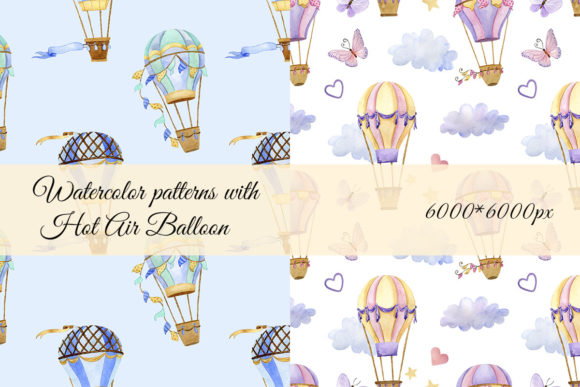
These are two hand-drawn, seamless watercolor patterns featuring whimsical hot air balloons—each designed at 6000 × 6000 pixels, 300 dpi, and delivered as high-resolution JPG files. The balloons float freely across soft, translucent washes and subtle granulation, evoking the gentle spontaneity of real watercolor painting. No digital gradients or vector precision here—just authentic texture, organic edges, and breathable negative space that invites layering and adaptation.
Why this matters—depending on who you are
What feels like a simple design asset shifts meaning dramatically across roles and goals. A teacher planning a classroom bulletin board doesn’t need commercial licensing details—but they do need clarity on print size and compatibility with free editing tools. A small-batch stationery maker needs reliability at scale and clear usage rights. A blogger designing an Instagram story template values speed and visual cohesion over archival paper fidelity. None of these priorities cancel each other out—they just require different kinds of attention.
For beginners exploring digital creativity
If you’re just learning how to use Canva, Photoshop Elements, or even Google Slides, these patterns lower the barrier to polished results. You don’t need to draw from scratch or understand color separation—you can drag and drop into a greeting card layout and immediately see how the soft watercolor texture lifts flat typography. Because both patterns are seamless, they tile smoothly across large areas (like a full-page invitation background) without visible repeats. Try resizing one to 50% in your editor: it still holds detail, thanks to the 300 dpi resolution and generous pixel dimensions.
For educators and community organizers
You might be preparing welcome materials for a summer camp, designing a “Dream Big” classroom display, or illustrating a lesson about travel, geography, or aspiration. These balloons carry lightness and possibility—not cliché, but quiet symbolism. Since the files are JPGs (not layered PSDs), they open instantly in free software like Paint.NET or Apple Preview. You can print them directly onto cardstock for student cut-outs, or overlay them with editable text boxes in PowerPoint to label continents or flight paths. No subscription required. No font pairing stress. Just warmth, clarity, and room for your voice to lead.
For makers and small business owners
If you sell printed fabric by the yard, hand-bound journals, or custom wedding suites, quality and scalability are non-negotiable. At 6000 × 6000 pixels, these patterns support sharp output up to 20" × 20" at 300 dpi—a size that covers most fabric swatches, notebook covers, and invitation suites without interpolation. The watercolor grain remains legible, not blurry, even when scaled down for social media thumbnails. And because they’re hand-drawn—not algorithmically generated—they carry subtle variation that helps your products feel human-made, not mass-produced. One user printed them on cotton-linen blend napkins for a boutique picnic brand; another embedded them into a printable planner cover sold on Etsy. Both reported customers commenting on the “soft but intentional” feel.
For designers and freelancers
You likely already know how rare it is to find seamless watercolor patterns that balance delicacy with versatility. Many default to oversaturated colors or rigid spacing—making them hard to pair with photography or handwritten fonts. These two variations solve that: one features clustered balloons in varying sizes and muted sky tones (soft blues, dusty rose, warm gray); the other spreads them more sparsely across a near-white ground, leaving generous breathing room for text or photos. Neither competes with content—you can drop a photo on top and still read facial expressions. You can also extract individual balloons using selection tools (thanks to clean edges and moderate contrast) and reposition them as standalone icons. That flexibility saves time during client revisions.
For hobbyists and lifelong learners
This isn’t about building a portfolio—it’s about showing up for yourself with materials that feel joyful to use. Maybe you’re reviving a childhood love of watercolors but don’t have studio space right now. Or maybe you enjoy analog-digital hybrids: scanning your own sketches, then blending them with these patterns in Procreate. The hand-drawn origin means they respond well to texture overlays—try adding a faint linen or paper grain in your editor to deepen the tactile impression. Some users import them into Cricut Design Space to cut balloon-shaped vinyl decals; others use them as underlays for embroidery digitizing, tracing outlines by eye before stitching.
What to consider before downloading
- Ease of use: JPG format means universal compatibility—but no transparency or layers. If your project requires knock-out backgrounds or color adjustments, plan to edit in software that supports adjustment layers (e.g., Affinity Photo, GIMP, or Photoshop).
- Quality threshold: These aren’t low-res web graphics. They’re built for physical output: letterpress invitations, fabric dye-sublimation, foil-stamped stationery. If your current printer maxes out at 150 dpi, you’ll still benefit—but the full texture nuance shines best above 240 dpi.
- Flexibility vs. specificity: They’re not themed for birthdays or graduations—no confetti, no banners, no dates. That’s intentional. It means you can adapt them across seasons, audiences, and purposes without visual whiplash.
- Commercial value: Licenses typically allow unlimited personal and commercial use—including merchandise, digital templates, and client work—as long as you’re not reselling the pattern files themselves. Always verify the license terms included with your download.
How to tell if this fits your next project
Ask yourself: Do I need texture that feels handmade, not machine-perfect? Am I working with paper, fabric, or screen-based layouts where softness adds warmth—not distraction? Is my goal to support a message (celebration, curiosity, journey) rather than dominate it? If yes, these patterns serve as quiet collaborators—not center-stage performers.
They won’t replace technical illustration skills—but they may give you breathing room to focus on storytelling instead of rendering. They won’t automate your workflow—but they may shorten the gap between idea and execution by one thoughtful, ready-to-use layer.
Whether you’re sketching a first business logo on napkin margins or finalizing a limited-edition textile line, what matters is alignment: between tool and intention, between medium and meaning, between what you make and why it matters to someone else. These hot air balloon patterns hold space for that—not as decoration, but as gentle, grounded support.