35 Seamless Citrus Fruit Vector Patterns: A Versatile Design Resource for Creative Professionals
Designers, illustrators, surface pattern creators, and small business owners frequently face a recurring challenge: finding high-quality, flexible, and legally sound visual assets that balance aesthetic appeal with technical reliability. The 35 Seamless Citrus Fruit Vector Patterns collection directly addresses this need—not as a decorative novelty, but as a rigorously constructed toolkit built for real-world application across digital and print workflows.
What Makes These Patterns Technically Robust?
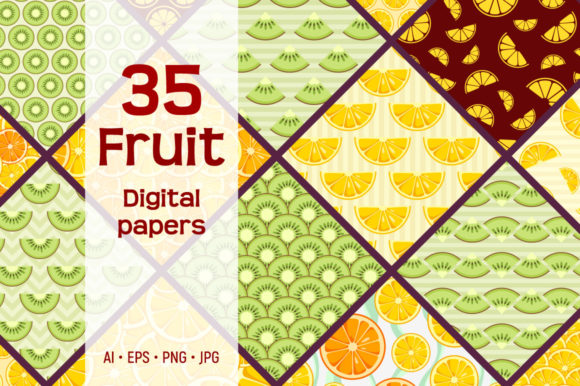
At its core, the collection is defined by precision and consistency. Each of the 35 designs—featuring stylized lemon slices, segmented oranges, kiwi cross-sections, and abstracted citrus motifs—is delivered in four complementary formats: AI (Adobe Illustrator), EPS (cross-compatible vector), JPG (high-resolution raster), and PNG (transparent-background raster). All raster files are sized at 5000×5000 pixels, rendered at 300 dpi, ensuring crisp output whether printed on fabric or scaled for large-format signage.
Crucially, every pattern is seamless, edited, repeated, and tileable. This isn’t implied—it’s verified. Unlike hastily tiled JPEGs or untested SVG exports, these patterns undergo manual alignment checks to eliminate visible seams, micro-gaps, or color shifts at tile boundaries. Each file includes a source swatch embedded in the native Illustrator swatch panel, enabling immediate drag-and-drop application into new documents without re-coloring or remapping.
Why Citrus? Functionality Meets Cultural Resonance
Citrus fruit motifs carry more than seasonal charm—they encode widely recognized associations: freshness, vitality, clarity, and approachability. Lemon yellows, tangerine oranges, and kiwi greens aren’t arbitrary choices; they form a harmonious, high-contrast palette rooted in natural color theory. These hues perform exceptionally well in both warm-light environments (e.g., summer-themed retail displays) and digital interfaces where legibility and emotional tone matter.
Importantly, the collection avoids literal photorealism. Instead, it employs clean vector linework, balanced negative space, and intentional simplification—making each pattern scalable without degradation and adaptable to varied stylistic contexts. A lemon slice pattern doesn’t compete with typography on a business card; it supports it. An orange segment motif doesn’t overwhelm a textile repeat—it anchors rhythm and texture.
Practical Applications Across Industries
The versatility of the 35 Seamless Citrus Fruit Vector Patterns emerges most clearly when mapped to concrete use cases—not hypothetical ones.
- Fabric & Surface Design: Textile designers use the AI and EPS files to build repeat layouts in programs like Adobe Illustrator or PatternMaker. Because each pattern is pre-tested for seamless tiling, developers avoid time-consuming manual offset corrections when adapting motifs for quilting cotton, linen napkins, or swimwear fabric.
- Digital Product Development: UI/UX designers integrate the PNG variants as subtle background textures in dashboard headers, onboarding screens, or email newsletter dividers. The 5000×5000px resolution allows generous cropping without pixelation—even on retina displays.
- Print & Packaging: Small-batch producers of artisanal food products, organic skincare, or eco-friendly stationery apply these patterns to labels, gift tags, and product boxes. The 300dpi JPG files meet commercial printer specifications without requiring additional resampling or sharpening.
- Educational & Presentation Materials: Educators creating summer-themed lesson plans, nutrition handouts, or science unit visuals use the transparent PNGs to overlay citrus motifs onto diagrams or infographics—enhancing visual coherence without obscuring content.
- Marketing Collateral: Local cafes, juice bars, and wellness studios incorporate the patterns into social media banners, Instagram story templates, and printable event posters. The bright, inviting palette reinforces brand messaging around health and energy—without relying on stock photography clichés.
Workflow Integration: How Designers Actually Use Them
Unlike static image libraries, vector-based seamless patterns support iterative, non-destructive design. For example, a graphic designer building a set of branded business cards might:
- Open the “Lemon Zest Grid” AI file, select the base swatch, and apply it to a background rectangle.
- Adjust hue saturation via the Recolor Artwork tool—shifting from sunflower yellow to muted ochre for a more sophisticated tone—while preserving seamless integrity.
- Overlay a white logo using Multiply blending mode so the pattern subtly shows through, adding depth without visual noise.
- Export final artwork as PDF/X-4 for print or PNG-24 for web—knowing the underlying pattern remains resolution-independent at every stage.
This kind of flexibility isn’t theoretical. It reflects how working professionals leverage vector assets: not as finished images, but as editable components within larger systems.
Licensing Clarity for Real-World Use
Understanding usage rights is essential for ethical and compliant implementation. The 35 Seamless Citrus Fruit Vector Patterns are licensed for personal use or small commercial use. That means they can be incorporated into client deliverables—such as a boutique’s packaging redesign or a teacher’s classroom resource bundle—as long as the pattern itself isn’t redistributed as a standalone asset.
Key boundaries include:
- You may embed a pattern into a poster, website background, or fabric print—provided it serves as a supporting element within a larger original composition.
- You may modify colors, scale, rotation, or layering—since all files are fully editable vectors.
- You may not resell the patterns individually, upload them to design marketplaces, or claim authorship of the original motifs.
- This is a digital download only; no physical items, printed samples, or mockups are included—managing expectations around deliverables.
Comparative Advantages Over Alternatives
Many designers evaluate similar resources—free pattern sites, subscription-based texture libraries, or custom commissions. What distinguishes this collection is its convergence of specificity and utility:
Free resources often lack vector fidelity, contain embedded watermarks, or offer inconsistent seamlessness across the set. Subscription services provide breadth but rarely focus on a single cohesive theme with coordinated color harmony. Custom illustration work delivers uniqueness but carries cost, timeline, and revision constraints.
In contrast, the 35 Seamless Citrus Fruit Vector Patterns deliver thematic unity, technical reliability, and immediate usability—all in one structured package. The inclusion of separate folders per pattern streamlines asset management, while the dual vector formats (AI + EPS) ensure compatibility across legacy and current software versions.
Considerations for Long-Term Implementation
While the collection excels in execution, thoughtful integration requires attention to context. For instance:
- Color Accessibility: Bright citrus palettes should be evaluated against WCAG contrast guidelines when used for text overlays. A high-saturation orange background may require dark charcoal—not black—for body copy to maintain readability.
- Scale Sensitivity: Some patterns, like tightly spaced kiwi seeds or fine lemon pith lines, may lose definition when scaled down below 15% in print. Previewing at actual output size prevents unintended visual flattening.
- Brand Alignment: Not every citrus motif suits every brand voice. A minimalist law firm would likely avoid exuberant tiling, whereas a children’s cooking class thrives on its energy. Selecting patterns intentionally—not just aesthetically—is part of professional judgment.
Who Benefits Most—and Why
The value of this collection scales with the user’s need for efficiency, consistency, and creative control. Freelance designers building multiple client brands benefit from having a go-to library that eliminates repetitive sourcing. Educators preparing seasonal curriculum materials gain time savings without sacrificing visual quality. Small manufacturers launching limited-edition product lines appreciate the ability to test pattern variations rapidly—changing only color or density rather than rebuilding entire layouts.
Even researchers studying visual perception or color psychology may find utility here: the collection offers a controlled set of variables (hue, shape complexity, repetition density) for comparative analysis—something difficult to assemble ad hoc.
Final Thought: Utility Anchored in Craft
The 35 Seamless Citrus Fruit Vector Patterns succeed not because they’re trendy or abundant—but because they solve specific, recurring problems with quiet competence. They respect the designer’s time by eliminating guesswork around tiling. They respect the end user’s experience by delivering predictable, high-fidelity output. And they respect creative integrity by offering editable foundations—not rigid templates.
In an era where visual fatigue is common and attention spans are short, well-executed, purpose-built assets like these don’t just decorate—they clarify, support, and elevate. Whether applied to a café menu, a science fair banner, or a sustainable fashion label’s fabric swatch book, their role remains consistent: to serve the idea, not overshadow it.