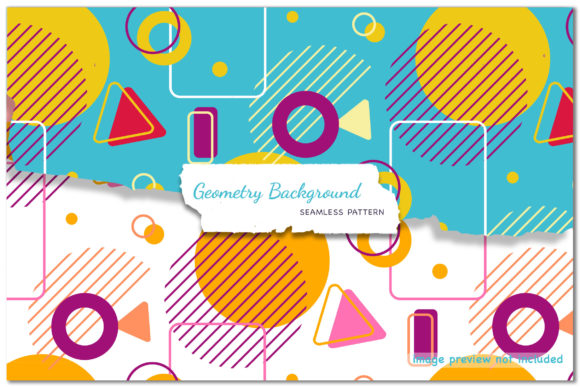
Geometry Background - Seamless Patterns: Precision, Versatility, and Real-World Design Utility
Seamless geometric patterns occupy a foundational role in visual communication—not as decorative afterthoughts, but as structural tools that shape perception, guide attention, and reinforce brand integrity. Among digital design assets, Geometry Background - Seamless Patterns stands out not for novelty alone, but for its rigorous technical execution and broad functional range. Unlike manually tiled or low-resolution repeats, this collection delivers mathematical consistency across scales and formats—making it equally suitable for a university lecture slide, a textile prototype, a mobile app UI overlay, or large-format architectural visualization.
What Makes a Pattern “Seamless”—and Why It Matters Beyond Aesthetics
A seamless pattern repeats infinitely without visible seams, breaks, or alignment artifacts at tile boundaries. Achieving this requires precise vector construction: anchor points must align exactly, paths must close cleanly, and bounding boxes must match the repeat unit’s dimensions with pixel-perfect fidelity. In raster formats like JPEG or PNG, this demands careful anti-aliasing control and consistent DPI handling; in vector formats (EPS, AI), it relies on non-destructive grouping, unexpanded strokes, and native Illustrator CC compatibility.
This precision isn’t merely technical—it translates directly into workflow efficiency. Designers working on responsive web interfaces can scale a single Geometry Background - Seamless Patterns file to fill any viewport width without distortion. Print production teams applying the same pattern to packaging, signage, or fabric rolls avoid costly re-rasterization or manual tiling corrections. Educators embedding these backgrounds into presentation decks retain clarity whether projected on a classroom projector or viewed on a student’s tablet screen.
Format Flexibility: Matching Output Needs to Technical Reality
The inclusion of EPS CC, AI CC, JPEG, and PNG versions reflects a deliberate response to real-world constraints—not just format parity. Each serves a distinct operational niche:
- EPS CC: Preserves full editability in legacy and cross-platform workflows. Preferred for print service providers using older RIP software or designers collaborating across Adobe and Corel environments. Maintains clipping paths, transparency layers, and CMYK color fidelity without relying on modern PDF/X standards.
- AI CC Version: Optimized for active editing within current Illustrator versions. Supports global colors, symbols, and Live Corners—enabling rapid customization (e.g., shifting hue via Recolor Artwork, adjusting stroke weight across all instances, or replacing a single shape in a symmetrical tessellation).
- JPEG: Delivers small file size and universal browser compatibility. Ideal for lightweight web overlays, email newsletter backgrounds, or CMS-based content where SVG support is inconsistent. Uses progressive loading and embedded sRGB profiles to ensure predictable color rendering across devices.
- PNG: Includes alpha channel transparency—critical for layering over photography, video stills, or gradient backgrounds. Used extensively in UI mockups, social media templates, and interactive prototypes where clean edge integration matters more than compression efficiency.
Crucially, all four formats share identical underlying geometry. A hexagonal grid in the AI file maps precisely to its JPEG counterpart at 300 PPI—no interpolation drift, no corner rounding, no subtle misalignment. That fidelity eliminates guesswork when switching between mockup (PNG), development handoff (JPEG), and final print production (EPS).
Practical Applications Across Disciplines
The utility of Geometry Background - Seamless Patterns emerges most clearly when observed in context—not as isolated graphics, but as integrated components solving specific challenges.
Education and Research Visualization
In STEM instruction, geometric repetition models abstract concepts concretely: tessellations demonstrate symmetry groups; Voronoi diagrams illustrate spatial partitioning; isometric grids scaffold 3D thinking. A physics lecturer might overlay a triangular lattice background behind force vector diagrams to subtly reinforce crystalline lattice structures. A statistics professor could use a modular grid to organize comparative data panels—each cell aligned to the same baseline, reinforcing methodological rigor.
Product Development and Prototyping
Industrial designers embed these patterns into CAD renderings to simulate surface texture before physical prototyping—testing how light interacts with micro-grooves or embossed geometries. UX researchers apply subtle dot grids as “eye-tracking scaffolds” in usability tests: participants’ gaze patterns reveal whether interface elements naturally align with perceptual anchors built into the background.
Brand Identity Systems
Rather than treating backgrounds as disposable decoration, forward-thinking brands use them as extension points of visual language. A fintech company might adopt a Fibonacci spiral variant—subtly reinforcing themes of growth, proportion, and algorithmic logic across dashboards, reports, and investor presentations. A sustainable apparel brand may choose a biophilic hexagon pattern echoing honeycomb or cellular structures, reinforcing ecological interconnectedness without literal imagery.
Architectural and Spatial Design
Interior designers scale Geometry Background - Seamless Patterns to full-wall murals using standard projection ratios—no stretching or warping. When applied to acoustic panel layouts or ceiling tile configurations, the pattern’s inherent modularity helps coordinate material specifications with structural grids. In parametric modeling software, the vector paths serve as direct input for CNC routing or laser-cutting templates.
Design Considerations That Go Beyond “Looks Nice”
Effective use hinges on understanding interaction dynamics—not just visual preference. Three considerations consistently separate functional implementation from superficial application:
- Contrast and Legibility: A dense triangular mesh may enhance depth perception but will overwhelm body text if used as a full-page background. Best practice: reserve high-frequency patterns for section dividers, headers, or subtle underlays beneath semi-transparent content containers—not primary reading fields.
- Perceptual Weight: Patterns with strong directional bias (e.g., parallel stripes, radial gradients) create implicit movement. This can guide users through multi-step forms or highlight sequential workflows—but may unintentionally compete with navigation elements if misaligned with information hierarchy.
- Cultural and Contextual Resonance: While geometry feels universal, interpretation varies. A square grid signals order and bureaucracy in some contexts; in others, it evokes stability and fairness. A Penrose tiling—non-repeating yet ordered—may communicate innovation to a tech audience but confuse general consumers unfamiliar with aperiodic structures. Intentional selection matters.
Workflow Integration: From Asset to Output
Adoption succeeds when integration feels frictionless—not when designers must “make time” for new resources. Teams report highest utilization when Geometry Background - Seamless Patterns fits naturally into existing pipelines:
- Web Developers: Reference PNG files directly in CSS background declarations (
background-image: url("grid-pattern.png"); background-repeat: repeat;). No JavaScript dependencies, no SVG-inlining complexity—just reliable, cacheable assets. - Marketing Operations: Upload EPS versions to DAM systems with metadata tags like “modular,” “monochrome,” “high-contrast,” enabling non-designers to filter by functional criteria—not just visual keywords.
- Educational Technologists: Import AI files into LMS authoring tools (e.g., Articulate Storyline) as layered slide masters—ensuring consistent branding across hundreds of course modules without manual replication.
- Print Production Managers: Use the EPS version in preflight checklists to verify bleed alignment, spot color registration, and overprint settings—catching issues before plates are burned.
Long-Term Value Beyond the Initial Download
Unlike trend-driven assets that age quickly, Geometry Background - Seamless Patterns gains utility over time. Its vector foundation ensures compatibility with future software updates. Its resolution-independent nature means a file used in 2024 remains fully viable in 2034—no need to re-export at higher DPIs or adapt to new aspect ratios. More importantly, its conceptual neutrality allows reinterpretation: a pattern initially chosen for a tech startup’s website may later serve as the basis for an academic journal’s cover design, simply by adjusting color mode and scale.
This longevity stems from adherence to first principles—not stylistic mimicry. It doesn’t chase “what’s popular this quarter.” Instead, it answers enduring questions: How do we structure visual space? How do we signal relationships without words? How do we maintain coherence across disparate outputs? Those questions persist. The patterns evolve only as our applications deepen—not as fashions shift.
Implementation Without Overcomplication
Start small. Identify one recurring pain point: inconsistent section dividers in documentation, mismatched background scaling across marketing channels, or time lost manually aligning grid guides in presentations. Apply a single pattern—choose the PNG for quick web testing, the AI file for editable refinement—and measure the time saved, the reduction in revision rounds, or the improvement in stakeholder feedback clarity. That concrete outcome—not theoretical versatility—is the true indicator of value.
Because at its core, Geometry Background - Seamless Patterns isn’t about filling empty space. It’s about providing a silent, reliable framework—one that lets content breathe, lets ideas connect, and lets creators focus on meaning rather than mechanics.