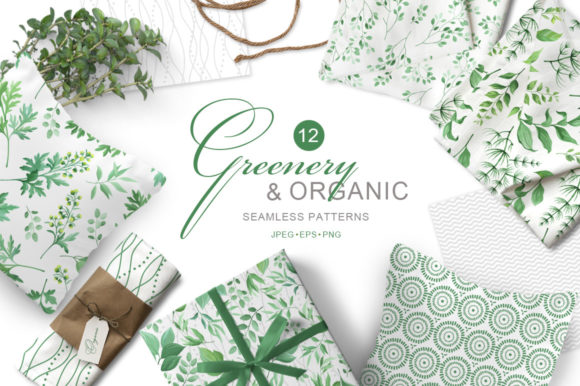
Greenery and Organic Seamless Patterns 2: Design Freedom Rooted in Nature and Geometry
Whether you’re printing botanical tea towels, developing eco-conscious packaging for a skincare line, or designing a calming wallpaper collection for wellness studios, Greenery and Organic Seamless Patterns 2 delivers more than just visuals—it delivers versatility, cohesion, and quiet confidence in every pixel and vector point.
This isn’t another generic pattern pack. It’s a thoughtfully balanced fusion of organic life and intentional structure—7 lush, hand-influenced green leaf motifs paired with 10 abstract geometric patterns split evenly between soothing green and grounded grey palettes. Together, they form a design ecosystem where ferns meet fractals, and symmetry supports serenity.
Why Seamless Matters—Especially When Scale Changes Everything
Seamless doesn’t just mean “no visible edges.” In practice, it means reliability. When you scale a pattern to wrap a tote bag, tile across a 12-foot wall, or repeat across 50 meters of fabric roll, the absence of breaks, misalignments, or awkward joins becomes non-negotiable. With Greenery and Organic Seamless Patterns 2, every file—whether EPS10, JPEG at 5000×5000px, or PNG with transparent background at 300dpi—is built and rigorously tested for true seamlessness.
That attention shows up in real workflows: no more manual cloning to hide seams in Photoshop, no last-minute panic when a client requests a larger-than-expected print size, and no compromise on clarity when zooming into embroidery mockups or product labels. The high-resolution JPEGs hold detail without bloating your workflow; the EPS files retain crisp scalability for laser-cut stencils or signage; and the transparent PNGs drop cleanly into mood boards, UI overlays, or layered textile previews.
The Leaf Collection: Botanical Warmth, Digitally Refined
The 7 green leaf patterns aren’t photorealistic scans—they’re stylized, rhythm-driven interpretations. Think layered monstera silhouettes with subtle texture grain, minimalist eucalyptus repeats with gentle spacing, or asymmetrical fern arrangements that flow like breath. Each balances natural irregularity with repeat precision.
They work especially well where warmth and approachability are priorities: baby clothing lines, ceramic studio branding, herbal supplement labels, or linen pillow covers for boutique hotels. Because they’re all green—but not *just* green—you’ll find variations from sage and olive to muted mint and deep forest tones. No neon. No jarring contrast. Just harmonious, livable color that feels grown, not generated.
Geometric Grounding: Green & Grey Abstracts That Anchor, Not Distract
Where the leaf patterns invite touch and pause, the 10 abstract geometric patterns provide structure and sophistication. Five in green offer soft geometry—think overlapping hexagons with gradient transparency, low-contrast tessellations, or rhythmic line grids that echo vine growth. These aren’t sharp or clinical; they’re softened by tone-on-tone layering and intentional negative space.
The five grey patterns serve as visual counterweights. They bring neutrality without coldness—charcoal circles with feathered edges, subtle concrete-textured grids, or minimalist dot matrices that recede just enough to let other elements shine. Use them as backgrounds under leaf motifs, as understated linings for gift boxes, or as subtle textures behind typography in sustainable brand guidelines.
Together, the green and grey geometrics let you build hierarchy effortlessly. Layer a bold leaf pattern over a muted grey grid for depth. Pair a delicate green geometric with a solid-color garment for quiet luxury. Or alternate between leaf and geometric repeats across a capsule collection—creating continuity without repetition.
Real-World Applications: From Sketch to Shelf
Designers don’t just download patterns—they solve problems. Here’s how Greenery and Organic Seamless Patterns 2 fits into actual projects:
- Textiles & Soft Goods: Print directly onto cotton canvas for reusable grocery bags—or scale down for micro-repeat scarves. The 5000×5000px JPEGs ensure clarity even on wide-format fabric printers.
- Packaging Design: Wrap a matte-finish soap box with a subtle grey geometric, then stamp the logo over a small-scale leaf motif. The transparent PNGs make die-line integration seamless (pun intended).
- Wallpapers & Interiors: Interior designers use the EPS files to adjust scale precisely in CAD or Revit. A large-scale leaf pattern adds life to a feature wall; a fine grey grid brings cohesion to a minimalist bathroom.
- Digital Products: App icons, loading screens, or SaaS dashboard backgrounds benefit from the clean geometry—especially the grey patterns, which reduce visual fatigue during long sessions.
- Stationery & Branding: Letterpress business cards gain tactile appeal when printed over a faint green geometric base. The EPS format ensures crisp vector output at any size—even engraved metal tags.
Workflow Considerations: What Designers Actually Need to Know
Before downloading, consider your output pipeline. If you’re working primarily in Adobe Illustrator or Affinity Designer, lean into the EPS10 files—they’re editable, scalable, and preserve layers where applicable. For quick mockups in Figma or Canva? The high-res JPEGs and transparent PNGs load instantly and maintain fidelity.
Note the resolution strategy: 5000×5000px gives headroom for cropping, scaling, or combining with other assets without degradation. And because all PNGs are at 300dpi with transparency, they integrate cleanly into print-ready PDFs—no white-box surprises when sending to a printer.
Also worth noting: this set avoids over-saturation. The greens are intentionally desaturated—not flat, but earthy. The greys avoid both sterile coolness and muddy warmth. That restraint makes mixing easier. You won’t need to manually adjust hue or brightness to get leaf and geometric patterns to coexist visually.
Mixing, Matching, and Making It Your Own
Don’t feel pressured to use patterns “as-is.” One of the quiet strengths of Greenery and Organic Seamless Patterns 2 is its compositional flexibility. Try these approaches:
- Overlay with opacity: Drop a light green geometric at 15% opacity beneath a full-coverage leaf pattern to add subtle rhythm without clutter.
- Crop + re-tile: Isolate a single leaf cluster from one of the JPEGs, convert it to a new seamless swatch in Photoshop—then rotate or flip it to create custom variation.
- Color-shift selectively: Using the EPS files, change one shape’s fill to match your brand’s secondary color—keeping the rest of the pattern intact.
- Combine across categories: Use a grey geometric as the base for a woven textile simulation, then embroider a leaf motif on top using the PNG as a placement guide.
There’s no “correct” way—only what serves your project’s voice, audience, and medium. That freedom is built in, not added on.
Final Thought: Sustainability Starts with Smart Sourcing
In a world of disposable design assets, Greenery and Organic Seamless Patterns 2 reflects a quieter kind of sustainability—not just in subject matter, but in utility. These aren’t trends chasing patterns. They’re tools built to last across seasons, clients, and creative evolutions. You’ll reach for them when launching a new product line, refreshing a website, or pitching a spatial concept—because they adapt without asking you to reinvent the wheel.
They’re green in color, yes—but also in intention: efficient, reusable, and rooted in craft. When your design choices feel intentional, not incidental, everything else follows with more clarity—and less noise.